MIT researchers join NSF’s new Center for Human and Robot Co-Adaptation
This article was originally published by MIT CSAIL.
MIT CSAIL researchers are joining the National Science Foundation’s (NSF) new Center for Human and Robot Co-Adaptation, where they’ll tackle a crucial question: What happens when assistive robots actually work with us?
The project is a five-year, $30 million collaboration between six universities, including the University of Texas at Austin, Yale University, Indiana University Bloomington, and Tufts University. A total of 39 researchers are joining the center, all studying how humans and robots live and collaborate.
The scientists’ goal? “Advance secure, useful robotic technologies that can support independent living, healthcare, and other human-centered services,” according to a recent press release from NSF.
Led by UT Austin, the center aims to establish a new science: human-robot co-adaptation. Researchers in this field will study how humans and machines, including humanoids and robotic arms, learn and adjust to each other’s tendencies over time in places such as homes, hospitals, care facilities, and even museums. And while robots aren’t yet commonplace in these settings, rapid developments in physical AI — that is, models that might eventually understand the real world just as well as chatbots understand the Internet — demand further studies into how these working relationships can flourish.
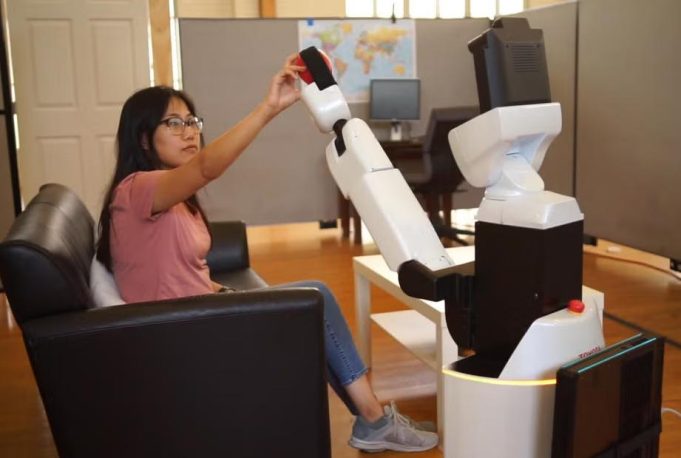
The robots will be deployed in real-world environments so engineers can study how, for example, caregivers in a nursing home want a robot to help them out, or how a student wants a robot to hand them a coffee mug. Humans might do each of these tasks a bit differently, and yet they’re second nature to each person. Meanwhile, our potential everyday assistants need these nuances to be explained more explicitly.
MIT researchers will play a pivotal role in developing the robots and helping them adapt to human colleagues. Dylan Hadfield-Menell, MIT associate professor of electrical engineering and computer science (EECS) and CSAIL principal investigator, will be the Institute’s campus lead. He’ll lead research teaching robots the basics — fundamental skills they need to begin working with humans.
“I’m really excited about how this work can develop skills for interaction and co-adaptation,” says Hadfield-Menell. “We typically think of robot skills as physical skills such as opening a door or stacking plates. This center will give us the ability to develop skills that help people teach the robot better or help the robot better understand human intent through follow-up questions and observation.”
Andreea Bobu, MIT AeroAstro assistant professor and CSAIL principal investigator, will join Hadfield-Menell at the center. She will lead research on the other piece of the puzzle: How individuals and robots adapt to each other.
“This center is a dream come true for HRI researchers,” says Bobu. “In our field, we usually study only half of the co-adaptation equation — how humans respond to robots or how robots learn from humans. Now we can study the whole loop at once, with real people and robots, in real environments.”
This loop can go many ways, according to Bobu. “A user’s trust grows as the robot improves, which makes the robot take on harder tasks, which raises expectations from the user; or if the robot consistently misunderstands, the user will be disappointed and eventually turn off the robot; or the robot could appear helpful but actually be a pretty clumsy partner and waste the person’s time.”
She adds that the center will help scientists understand how co-adaptation will progress, how the robot can prevent undesirable situations, and how the human can better understand what the robot can and can’t do. “Ultimately, it supports a vision for the future where robots are partners, instead of simple tools.”
The Center for Human and Robot Co-Adaptation will also work with companies such as Apptronik, Diligent Robotics, Google DeepMind, Hello Robot, MassRobotics, NVIDIA, and Robust AI. This team-up between academia and industry ensures leading computer scientists can use top AI models and robotics hardware. In turn, their research may accelerate our understanding of the robots that could make our lives easier at home and help save lives in healthcare settings.