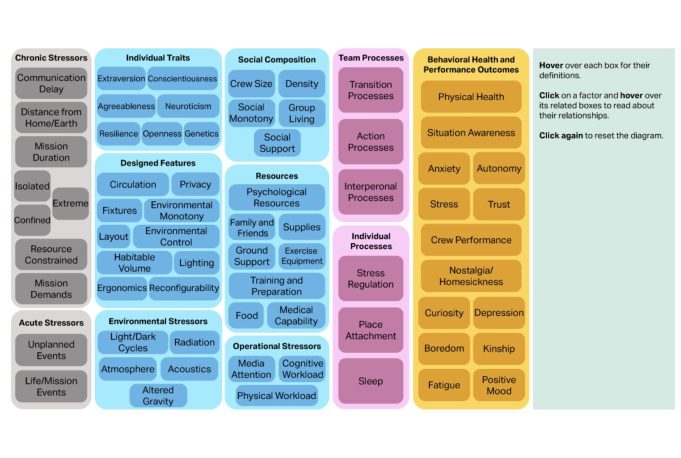
Interactive causal diagram of habitat design impacts on behavioral health and performance in extreme environments
As humans consider long-duration exploration missions to the Moon and Mars, there are outstanding questions about how to design spacecraft habitats to support crew wellbeing. Researchers in the Engineering Systems Lab leverage a Directed Acyclic Graph (DAG) to novelly formalize the influence of habitat design on behavioral health. The work involves an interactive visualization of this risk map as a habitat design tool for spaceflight and other isolated, confined, and extreme environments.
Authors: Mich Lin, Lu Chen, and Katya Arquilla
Citation: Accepted, npj Microgravity
Abstract:
As crewed long-duration space exploration missions become increasingly Earth-independent and
reliant on onboard technology, risks due to human-system incompatibility become critical to address. In a space habitat, establishing objective and meaningful relationships between the individual and the environment has been challenging due to multidirectional influences between system components. Feedback loops between behavioral health processes and outcomes complicate characterization of influence within the system. Yet, it remains crucial for habitat designers and stakeholders to trade design decisions and their associated risks. In this work, we have created a risk mapping of the impact of habitat design to behavioral health and performance outcomes in isolated, con ned, and extreme environments. We leverage a Directed Acyclic Graph (DAG) to formalize habitat design parameters as powerful mediators between mission stressors and behavioral health outcomes. To represent the DAG accessibly, we created the Human-Environment Connection & Interaction Atlas, an interactive open-source platform. We conducted expert and user interviews to evaluate the underlying DAG and the usability of the tool. Herein, we present our novel development of a risk map that links habitat design and behavioral health, as well as an interactive visualization that can provide a basis for accessible communication of complex systems.