Demonstration of a modal dark zone maintenance algorithm for high-contrast direct imaging
To search for life outside our solar system, NASA’s next space telescope, the Habitable Worlds Observatory, must completely block a host star’s blinding light with picometer-level precision to directly image Earth-like exoplanets. Researchers in STAR Lab have developed and successfully tested a new algorithm that acts as a continuous stabilizer, actively sensing and fighting off natural telescope vibrations to maintain this critical “dark zone.”
Authors: Saikrishna Manojkumar, Susan Redmond, Leonid Pogorelyuk, Christine Page, Garreth Ruane, AJ Eldorado Riggs, and Kerri Cahoy
Citation: SPIE Journal of Astronomical Telescopes, Instruments, and Systems Vol 12, Issue 4. June 2026
Abstract:
The Habitable Worlds Observatory requires sustained wavefront stability to maintain a high-contrast image while directly imaging exo-Earths. This high-contrast region in the image, dubbed the dark zone (DZ), is affected by mechanical and thermal instabilities, which progressively degrades the contrast and the scientific yield of the observation. Focal plane high-order wavefront sensing and control (HOWFSC) algorithms such as Dark Zone Maintenance (DZM) have been proposed to maintain contrast and correct the drifting wavefront by estimating the electric field at each pixel of the science camera using an Extended Kalman Filter (EKF). However, estimating the electric field in a pixel-bypixel basis may not capture all correlations between pixels and can be overly sensitive to photon and detector noise, necessitating large probe magnitudes. Hence, a modal DZM (MDZM) approach has been proposed using an EKF to estimate the drifting wavefront modes in the basis of the deformable mirrors (DM) actuators used for wavefront control.
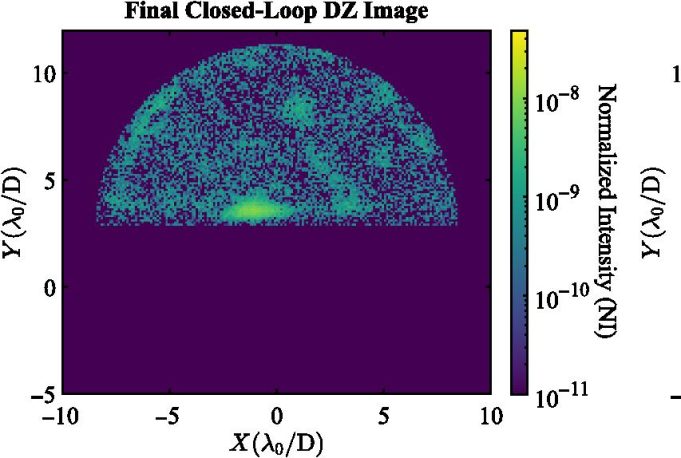
This approach directly provides the DM commands to null the aberrations, allowing for the maintenance of contrast in the DZ closer to the theoretical bounds as compared with DZM. We present the first-ever hardware demonstration of the MDZM algorithm on the Decadal Survey Testbed (DST) at NASA JPL. On this in-vacuum testbed, under three varying drift conditions, the MDZM algorithm was able to maintain a normalized intensity (NI) as good as ∼3×10⁻¹⁰ for over 36 h of experiment time, suppressing over 1.5 orders of magnitude of NI degradation. These results illustrate the validity of this algorithm to maintain contrast as a focal-plane HOWFSC algorithm while allowing simultaneous scientific observing at HWO desired contrasts.