Surface power demand modeling for human martian and lunar missions
Engineering Systems Lab researcher Yana Charoenboonvivat and Prof. Olivier de Weck developed a method to estimate the extraterrestrial power needed to support human missions on the Moon and Mars.
Authors: Yana Charoenboonvivat and Prof. Olivier de Weck
Citation: AIAA SCITECH 2026 Forum, 12-16 Jan 2026
Abstract:
Growing interest in establishing a sustained human presence on the Moon and Mars has driven the need to characterize fundamental resource demands. Surface power is among the most critical of these resources, supporting life support systems, scientific activities, habitat operations, and in-situ resource utilization (ISRU). This study addresses this need by developing a tool to quantify surface power demand for crewed missions to the Lunar and Martian surface. Although prior studies have produced power demand estimates, their accuracy can be improved by incorporating thermal power required to regulate internal habitat temperatures for crew safety and comfort, improving traceability, and providing hourly resolution power data rather than mission-averaged values.
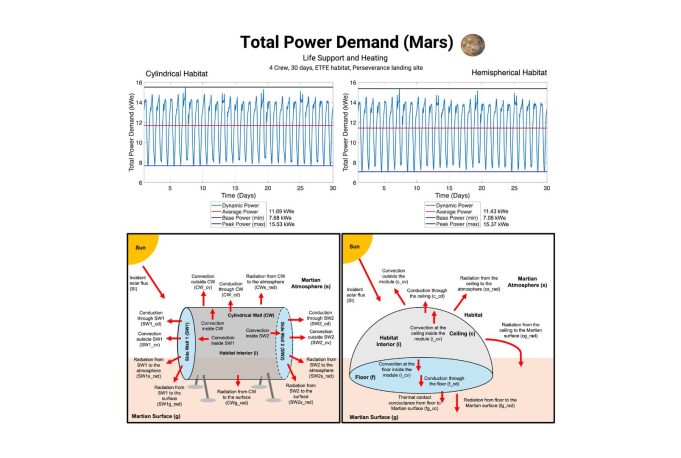
To support this need, updates were made to HabNet, a MATLAB tool that takes in key mission parameters and outputs predictions of resource levels required at hourly intervals. The primary update presented in this work is the implementation of a thermal power demand model, which enables HabNet to account for the power required to maintain habitable internal temperatures in the extreme environmental conditions of the Moon and Mars. Using the implemented thermal power demand model, power demand results were produced for a Martian habitat with a hemispherical form factor over 24 hours. Parameters varied in the study include the habitat volume, habitat material, target internal habitat temperature, convective heat transfer coefficient of air inside the habitat, convective heat transfer coefficient of Martian air, habitat thickness, and thermal contact conductance coefficient between the Martian surface and habitat floor. The peak thermal power demand observed was 90kW while the minimum power demand (maximum power required to be rejected) was -40kW, rounded to the nearest 10kW. Diurnal variations in thermal power demand were on the order of 10 kW, which is non-negligible for system-level mission design considerations.