Interdisciplinary MIT teams design power, communications, and early lunar industries to win top honors in NASA innovation competition
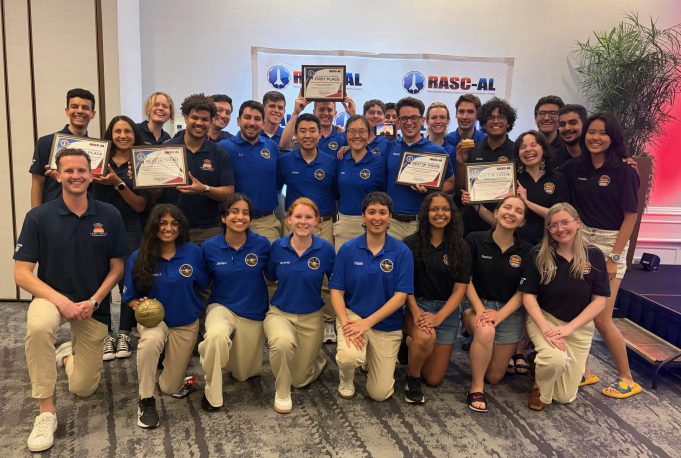
Three MIT teams took five top awards in the 2026 NASA RASC-AL Competition for designing critical elements for the Moon Base and future missions to Mars.
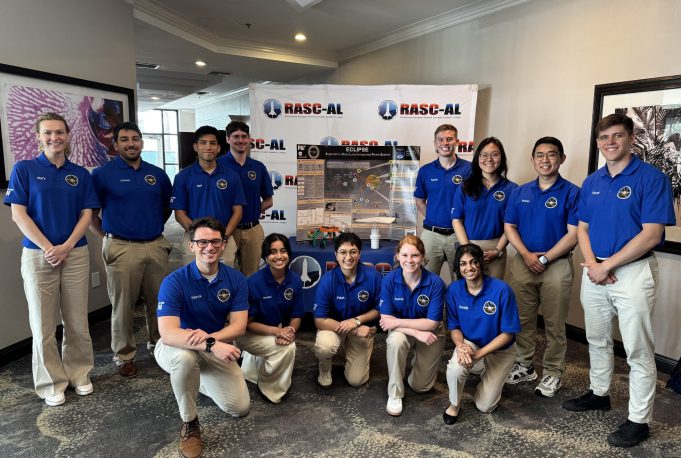
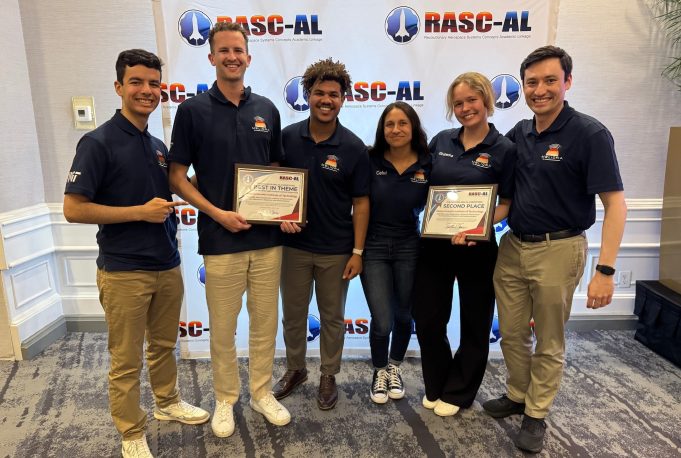
Three teams comprising 35 students across eight different departments and Wellesley College have been at work since fall of 2025, designing critical early infrastructure elements that a Moon Base would require. This June, their designs were recognized with five awards at NASA’s 2026 Revolutionary Aerospace Systems Concepts — Academic Linkage (RASC-AL) Forum.
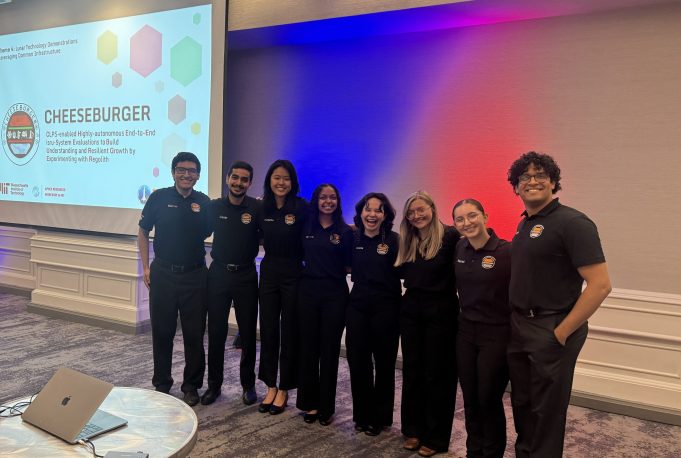
Among 75 submissions and 14 finalists, the MIT teams earned first and second place in the competition, as well as three best in theme awards. The Exploration-Class Lunar Integrated Power SystEm (ECLIPSE) team won first place overall and first in its theme category, lunar surface power. The communications and navigation constellation team, MELIORA, won second place overall and first in its theme category on Mars communications, position navigation and timing, which included a strategy for proving the design at the Moon. And CHEESEBURGER, a campaign to mine and process lunar regolith into oxygen, metals and bricks, won first in its theme category, lunar technology demonstrations.
“NASA spent the spring telling the world what critical early infrastructure their upcoming permanent Moon Base will need”, says George Lordos, PhD, a research scientist and lecturer in the Department of Aeronautics and Astronautics (AeroAstro) and in System Design and Management (SDM), who co-advised all three teams. “Over thirty MIT students spent this academic year designing much of the Moon Base — systems for generating, storing and distributing power, robust systems for positioning, navigating and communicating, and early experiments with essential technologies to live sustainably off the Moon’s own dirt.”
A power grid for surviving lunar night and winter
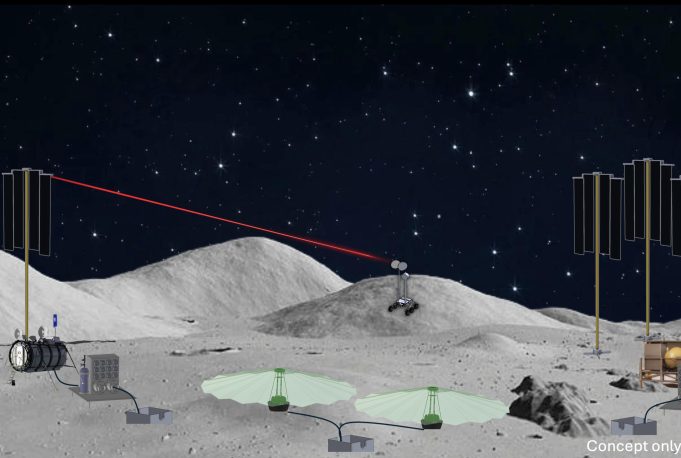
The hardest constraint on NASA’s Moon Base is staying powered, because a failure in life-support power would doom the crew within hours. ECLIPSE is a reference design for a lunar grid engineered to stay up for more than 99.995 percent of the time — fewer than 27 minutes of downtime a year in the worst-case scenario, the standard demanded of the most critical data centers on Earth. It pairs two power sources that fail in different ways: banks of 20-meter solar masts in the sunlit highlands near the south pole, and, for the roughly 18-day stretch each year when the sun drops below the horizon, a pair of buried 20 kilowatt microreactors the team named CARROT, (Compact Autonomous Regolith-shielded Reactor Operating for Ten years). The CARROT reactor, a novel design developed independently by the ECLIPSE team, ended up being similar in design to NASA’s SR-1 reactor for the 2028 mission to Mars, both aiming to maximize speed-to-deployment.
“Burying each reactor 1.3 meters down shrinks the keep-out zone from kilometers to meters, so crews can work nearby, and it saves tons on required shielding mass,” says Taylor Hampson, a PhD student in the Department of Nuclear Science and Engineering and ECLIPSE team co-lead.
The full design delivers an initial 120 kilowatts using a grid of buried aluminum cables and shielded direct-current power equipment. Laser-equipped rovers provide “Frontier Power” capability, beaming up to 10 kilowatts to sites beyond any cable, from a shadowed crater to a new outpost before its own grid exists. Patrick Riley, a graduate student in the Department of Aeronautics and Astronautics and ECLIPSE team co-lead, says the design’s point is to put reliability ahead of mass: “We sized it so the most likely failures never reach the Moon Base inhabitants, and so it scales from a first crew of six up to industrial demand without interrupting a commercial lunar economy.”
A network for exploring the Moon and Mars, and calling home
MELIORA acts as the base’s relay and GPS. Although RASC-AL framed the communications, positioning, navigation and timing competition sub-theme around Mars, the team also proposed a plan to validate their design in lunar geometry first, in step with the agency’s strategy to prove technology on the Moon before extending it to Mars. To find the best design, the team ran a trade study across 5,764 candidate constellation geometries. The result grows from an initial 3 satellites to 23, returns more than 100 megabits per second to Earth-orbiting data networks over free-space optical links, and pins a user’s position to within 10 meters. For the Mars design, 4 relay satellites parked at gravitationally stable Lagrange points keep the link alive even during solar conjunction, the weeks when the sun sits between the two worlds and ordinarily cuts communication. On the surface, a user needs only a portable radio terminal and a chip-scale atomic clock — a timekeeper the size of a matchbox.
“You should never have to think about whether the network is there — it just is, the way you don’t think about a cell tower,” says Ekaterina Tiukhtikova, an undergraduate studying both AeroAstro and EECS, and a MELIORA team co-lead. “We put almost all the complexity up in orbit, so everything on the surface stays portable and simple,” added Clayton Lieberman, a graduate of the SDM program and team co-lead who wrote his thesis on MELIORA.
Making oxygen, metal, and bricks from lunar dirt
After power and communications, the third essential pillar of a lunar base is living off the land. The Moon’s own regolith can supply oxygen to breathe and burn, metal to build with, and shielding to hide behind for protection from deadly radiation. CHEESEBURGER is a campaign of five robotic payloads that prove the supply chain one link at a time, followed by integration of the five into the first end-to-end lunar industry.
The payloads carry a kitchen’s worth of names: SWISS prospects for the richest ore, BRIOCHES digs and sorts the regolith, BACON casts it into bricks, GRILLED MEAT melts it electrically to pull out metal and oxygen, and AVOCADO is the robotic builder that stacks the products into structures, including interlocking Moon BRICCSS that shield a habitat from radiation. The food theme was born during a January team outing at Sandwich, MA. “Naming the prospector SWISS and the metal extractor GRILLED MEAT turned a wall of acronyms into something the whole team could enjoy,” says Cesar Meza, a graduate student in AeroAstro and CHEESEBURGER co-lead. “It sounds like a joke until you see that each acronym clearly describes a serious piece of hardware doing one job in the pipeline.”
30 students, 8 departments, 3 teams for one Moon Base
More than 30 students contributed across the teams, from AeroAstro, System Design and Management, Nuclear Science and Engineering, Electrical Engineering and Computer Science, Mechanical Engineering, the Technology and Policy Program, the Sloan School of Management and Earth, Atmospheric and Planetary Sciences, along with a student from Wellesley College. Several student mentors and faculty advisors worked across more than one team, which is why ECLIPSE’s grid is sized to power CHEESEBURGER’s processing, CHEESEBURGER’s regolith handling is used to bury and shield ECLIPSE’s grid, and all three projects are designed to translate Moon Base learnings for a future mission to Mars. The teams were advised by Olivier de Weck, the Apollo Program Professor of Astronautics and Engineering Systems and interim department head of AeroAstro, who led ECLIPSE; Kerri Cahoy, the Sheila Evans Widnall Professor of Aerospace Engineering, who led MELIORA; Jeffrey Hoffman, professor of the practice in AeroAstro and a former NASA astronaut, who led CHEESEBURGER; Koroush Shirvan, Atlantic Richfield Career Development Professor in Energy Studies in Nuclear Science and Engineering, who co-advised ECLIPSE; and Lordos, who co-advised all three. Much of the day-to-day mentorship work is led by PhD student volunteers and runs through the MIT Space Resources Workshop, which Lordos founded in 2019.
“The winning teams demonstrated how academic innovation can support Artemis mission goals,” said Daniel Mazanek, RASC-AL program sponsor and senior space systems engineer at NASA’s Langley Research Center, in NASA’s announcement of the awards. “Their work highlights the important role student research plays in shaping future space exploration.”
NASA expects astronauts living on the lunar surface for months at a time by the early 2030s — the window ECLIPSE, MELIORA, and CHEESEBURGER were designed for. The picture the three teams had worked toward is unified: a crew at the lunar south pole, the lights on through the winter night, the network always up, and the first oxygen and bricks coming out of the ground beneath them.
“A permanent base is no longer a slide in a strategy deck; NASA begins landing the first elements in 2027,” says de Weck. “Studies like these three let the agency see, before the concrete sets, how its power, communications, and resource choices depend on one another. That is precisely when independent, integrated architecture work has the most influence on the real plan.”
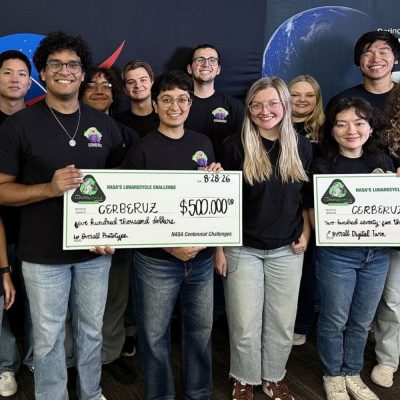
RASC-AL is administered by the National Institute of Aerospace on behalf of NASA. MIT has a long record in NASA’s student design competitions, with recent winning teams including the HYDRATION Mars water production system,, the Pale Red Dot Mars homesteading architecture, the deployable lunar tower MELLTT, the MARTEMIS lunar Mars analog campaign, the MAPLE autonomous lunar robot pathfinding system, the CERBERUZ lunar recycling project and the THERMOS cryogenic fluid management system. This work was supported in part by NASA, the Massachusetts Space Grant, MIT AeroAstro, and the MIT Space Resources Workshop. One student was supported by a NASA Space Technology Graduate Research Opportunity Fellowship.
The full teams:
ECLIPSE — Team leads: Taylor Hampson (graduate student, Nuclear Science and Engineering) and Patrick Riley (graduate student, AeroAstro). Reactor team: Liliana Arias, Sydney Menne, Julian Rocher and Pavel Shilenko (graduate students, NSE). Power management and distribution team: Evrard Constant and Mary Foxen (graduate students, AA), Janhavi Joglekar and Asma Patel (undergraduate students, AA). Solar and architecture team: Zachary Dawson (graduate student, System Design and Management), Sreeja Akula and Ian Jimenez (undergraduate students, AeroAstro; Earth, Atmospheric and Planetary Sciences), Yohan Lim (graduate student, AeroAstro/Technology and Policy Program), CJ Taglienti (graduate student, AeroAstro/MBA). Student co-advisors: Yana Charoenboonvivat, Lanie McKinney (AeroAstro), Palak Patel (MechE). Industry mentor: Sully Marigliano-Crevecoeur (Technetics). Faculty: Olivier de Weck (lead) and Jeffrey Hoffman (AeroAstro), George Lordos (AeroAstro and SDM), and Koroush Shirvan (NSE).
MELIORA — Team leads: Clayton Lieberman and Katiyayni Balachandran (System Design and Management), Ekaterina Tiukhtikova (undergraduate, AeroAstro and EECS), Celvi Lisy (AeroAstro). Team members: Thomas Harrington and Zachary T. Barnes (System Design and Management), Asael Acosta (undergraduate, AeroAstro). Student co-advisor: Lanie McKinnery (AeroAstro). Faculty: Kerri Cahoy (lead), Jeffrey Hoffman and Olivier de Weck (AeroAstro), and George Lordos (AeroAstro and SDM).
CHEESEBURGER — Team leads: Cesar Meza (graduate student, AeroAstro) and Elizabeth Romero (undergraduate, AeroAstro). Team members: Rachel Dunphy, Shreya Kothnur, Hailey Polson (undergraduates, AeroAstro), Christopher Kwon, Jose Soto, Lanie McKinney (graduate students, AeroAstro), Marvin Martinez (undergraduate, Mechanical Engineering), Ananda Santos Figueiredo (graduate student, Technology and Policy Program), Evangeline Haiqi Wang (undergraduate, Computer Science and Psychology, Wellesley College). Faculty: Jeffrey Hoffman (lead) and Olivier de Weck (AeroAstro), and George Lordos (AeroAstro and SDM).