Aimee Maurais PhD ’26 receives SIAM Student Paper Prize for work on efficient uncertainty quantification
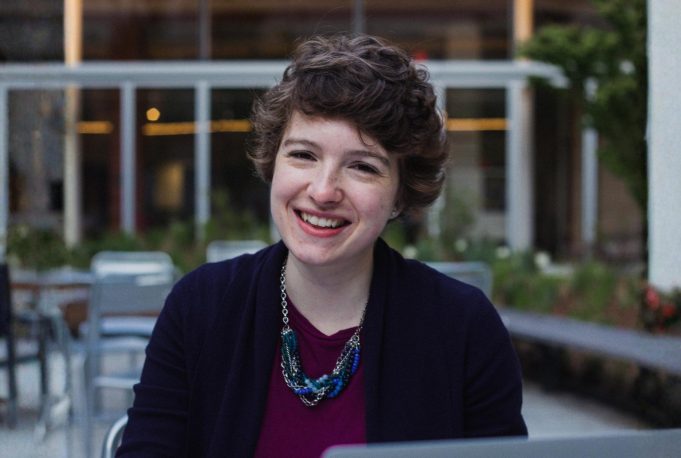
Aimee Maurais PhD ’26 has received a SIAM Student Paper Prize from the Society for Industrial and Applied Mathematics for her paper, “Multifidelity Covariance Estimation via Regression on the Manifold of Symmetric Positive Definite Matrices.” The annual award recognizes the student authors of the most outstanding papers accepted by Society for Industrial and Applied Mathematics journals within the three years preceding the nomination deadline. Maurais,who received a doctoral degree from the interdisciplinary program in the MIT Center for Computational Science and Engineering, is one of three recipients this year.
The paper presents a new approach for estimating covariance matrices that combines high- and low-fidelity data to produce more accurate, mathematically robust estimates. This method significantly outperformed existing techniques in numerical tests and has applications in machine learning, data assimilation, and uncertainty quantification. The approach could enable engineers to pair fast, simplified simulations with more detailed models to make better predictions about complex systems, including atmospheric physics and aircraft in motion, without the time and expense of relying on high-fidelity simulations alone.
The paper was co-authored by Terrence Alsup (NYU), Benjamin Peherstorfer (NYU), and Prof. Youssef M. Marzouk.
Maurais’ achievement was recognized at SIAM’s 2026 Annual Meeting, where she presented the work in a featured session on Wednesday, July 8.
Maurais was also interviewed about the research for SIAM’s July 2026 Prize Spotlight. Read the conversation below:
Q: Why are you excited to receive the award?
A: I presented an early version of this work at my first in-person conference of graduate school, the 2022 SIAM Conference on Uncertainty Quantification (UQ22). Now that I’ve completed my Ph.D., it’s fun to come full-circle and present it again at AN26 as part of receiving this award.
Q: What does your work mean to the public?
A: Very accurate, or high fidelity, computational models of physical systems we need to simulate—like atmospheric physics or airflow over an airplane wing—are usually very expensive to run on a computer, which limits the number of times we can evaluate them in order to make predictions under uncertainty. Less accurate, or low fidelity, models are cheaper but may not resolve important physical phenomena. Our work introduces a geometrically grounded method for combining both high- and low-fidelity models in order to enable accurate uncertainty quantification at a manageable computational cost.
Q: Could you tell us about the research that won you the award?
A: In our paper we introduce a regression-based framework for multifidelity estimation of objects, like covariance matrices, which reside on Riemannian manifolds. Our approach enables more accurate estimation of these objects for a given computational budget by combining models of multiple fidelities and naturally preserving important structural properties, like positive definiteness, in the final estimates.
Q: What does being a member of SIAM mean to you?
A: SIAM is a great community that has played a huge role in my professional development. One reason why I decided to pursue a PhD was due to a positive experience I had as an undergraduate at the 2019 SIAM Conference on Computational Science and Engineering. Attending SIAM conferences was a highlight of my graduate school career, and I look forward to being a SIAM member for years to come!