Three from AeroAstro awarded 2026 Amelia Earhart Fellowships
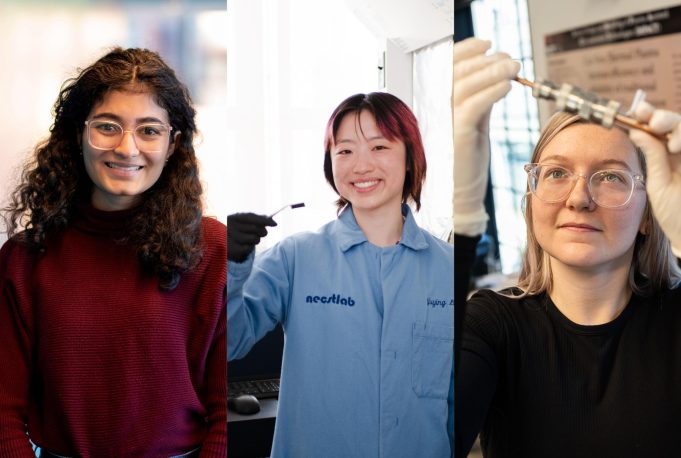
Jasmine Jerry Aloor (DINaMo), Yuying Lin (necstlab), and Lanie McKinney (APG) have been named 2026 Amelia Earhart Fellows by Zonta International. The annual award includes a $10,000 fellowship, given to to up to 30 women pursuing doctoral studies in aerospace engineering or space sciences. They join numerous AeroAstro awardees from previous years, including Myrella Cabral and Palak Patel in 2025, and Mennatallah Hussein, Madelyn MacRobbie, and Hannah Tomio in 2024.
About the winners:
Jasmine Jerry Aloor is a PhD candidate in the Dynamics, Infrastructure Networks and Mobility (DINaMo) Group, advised by Professor Hamsa Balakrishnan. Her doctoral research develops multi-agent reinforcement learning frameworks for the safe, fair, and decentralized coordination of autonomous aircraft in advanced air mobility systems.
Her work addresses how autonomous aircraft can learn to coordinate using only local information, while maintaining safety, equitable resource sharing, and structured traffic flows. Her contributions span fairness-aware navigation, layered safety architectures combining control barrier functions with multi-agent learning, and decentralized corridor-based traffic management for autonomous aircraft. Before MIT, Aloor earned a Dual Degree (Bachelor and Master of Technology) in Aerospace Engineering with a minor in Computer Science from the Indian Institute of Technology Kharagpur, where she graduated first in her cohort, received the Institute Silver Medal, and was awarded the Boeing Scholarship as one of the top two senior undergraduate students in her department. Her doctoral studies have been previously supported by two MIT MathWorks Fellowships.
Aloor is passionate about advancing women’s representation in aerospace. She serves as Regional Operations Manager for WeLEAP Aerospace, co-leads MIT’s Graduate Women in Robotics Community, and is Communications Chair of the AIAA Aviation in Multimodal Transportation Integration and Outreach Committee. She also serves as a peer support resource through the Resources for Easing Friction and Stress (dREFS) program. In her free time, she enjoys painting, jigsaw puzzles, and spending time with family and friends
Yuying Lin is a PhD student in necstlab, advised by Prof. Brian Wardle. Her research focuses on ultra-light structural nanocomposites for multifunctional aerospace and energy applications. More specifically, she develops aligned nanotube reinforced thermoplastic and ceramic matrix composites, with applications ranging from more sustainable aerospace structures and additive manufacturing to ultra-high temperature environments. At MIT, her interest in space has also led her to work on designing inflatable space boots and life support systems to sustain a human presence on Mars.
Lin holds a bachelor’s degree in chemical engineering from the California Institute of Technology, where she conducted a variety of space-related research such as developing luminescent solar concentrators for the Caltech Space Solar Power Project and modelling the vibrational kinetics of oxygen behind hypersonic shockwaves. More recently, she has incorporated sustainability and policy into her work. She interned at CEA-Léti and Université Grenoble Alpes in France, where she examined lifecycle assessment methodologies for advanced manufacturing and explored the interaction between policy and deployment of sustainable technologies.
In addition to her passion for aerospace and sustainability, she cares deeply about equitable access to space education and space itself. She mentors undergraduate researchers and works with prospective graduate students from underrepresented backgrounds on their applications to the MIT AeroAstro program. In the long run, she hopes to increase the accessibility of space and clean energy technologies through commercialization and policy work.
Lin’s hobbies include practicing and competing in taekwondo, making music in GarageBand, writing Chinese calligraphy, and exploring nature.
Lanie McKinney is a PhD student in the Aerospace Plasma Group, advised by Professor Carmen Guerra-Garcia. Her research focuses on plasma chemical conversion technologies that could one day let astronauts manufacture propellant and life-support resources directly from the Martian atmosphere.
McKinney earned dual Bachelor of Science degrees in physics and applied mathematics, graduating summa cum laude from the University of Tulsa, and went on to receive a National Science Foundation Graduate Research Fellowship to support her graduate studies. She earned her Master of Science in Aeronautics and Astronautics from MIT in 2024. Her master’s and PhD research both focus on reactor design for CO₂ conversion in pulsed plasma discharges, to improve the performance and advance the technology readiness of these systems.
Beyond her plasma research, McKinney is passionate about advancing the technologies and ecosystems that will enable humanity’s exploration and utilization of space. She has served as co-president of the MIT Sloan Space Industry Club, building partnerships with commercial space companies and organizing the annual MIT New Space Age Conference. She is a co-inventor of a regolith brick system designed to shield lunar habitats from radiation and micrometeoroids.
As president of the MIT Space Resources Workshop, she helped establish ten new teams over the past three years, which have collectively earned more than ten NASA-recognized awards. As project lead for MARTEMIS, she guided a 20-person team to a Best in Theme award at the NASA RASC-AL Challenge, and she currently co-leads CERBERUZ, a NASA Centennial Challenge LunaRecycle team awarded $150K to develop a recycling and manufacturing system for a lunar base. For this work, she received MIT Aeronautics and Astronautics’ Apollo Program Prize for Excellence in Systems Engineering.