Conceptual design of an electric semi-autonomous taxiing system for commercial aviation
Current aircraft taxiing relies on running engines and pilot control, which drives up fuel use, emissions, noise, costs, and safety risks. Because taxiing follows structured paths, it’s well-suited for automation and electrification. Researchers in ICAT propose an electric, semi-autonomous system using a towbarless tug to move aircraft between the gate and runway more efficiently and safely.
Authors: Benjamin Levy, Razvan Pretorian, Edward Burnham, Yiming Hu, and R. John Hansman
Citation: AIAA Aviation Forum 2026 Conference, June 2026
Abstract:
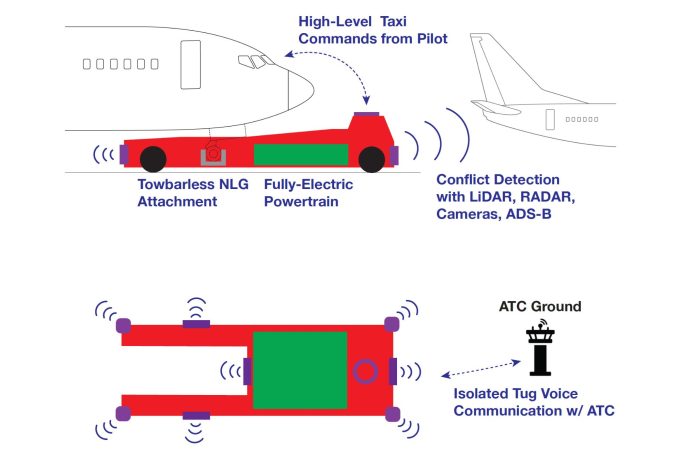
Current procedures for commercial aircraft taxiing at towered airports rely on a single or multiple engines for power and the pilot for direct control of the aircraft. Undesirable features of engine-on, pilot-controlled taxiing include fuel and personnel costs, greenhouse gas and particulate emissions, noise, and ground collisions. Due to its structured nature, taxiing has emerged as a strong candidate for autonomy and electrification. This work presents the design of an electric, semi-autonomous taxiing concept, which consists of an electric, towbarless tug that escorts the aircraft between the gate and runway. Key system capabilities include collision avoidance enabled by integrated LiDAR, RADAR, and visual cameras, as well as full autonomous capability when disconnected from the aircraft. Initial sizing and design of the tug yields favorable operating costs compared to the fuel savings enabled by engine-off taxiing. A key risk for the system is the power and energy requirements for full deployment at large airports. An initial study of full deployment at Boston Logan Airport yields an electrical energy requirement of 9.91 million kWh per year, equating to 2.17 million USD in added energy costs per year, a fraction of the fuel savings enabled by engine-off taxiing. A thorough sizing analysis is presented that considers operation at Boston Logan Airport.
A key outcome of this study is the design of the electrical power system, including the drivetrain and battery, as well as dimensions of the tug vehicle. Analysis of an operational scenario indicates a high degree of energy usage flexibility throughout a typical day, reducing risks associated with electrical energy infrastructure. Key benefits of such a system include fuel cost reduction (37 million USD/year for BOS), ground crew cost reduction (1.4 million USD/year for BOS), emission reductions, noise reductions, and safety. Opportunities for concept development are centered around enhancing the level of autonomy and sensing capabilities of the system. Possible business approaches are service-based and product-based models, each addressing constraints of major stakeholders, which include airlines, airport authorities, and ground service companies.