Modeling the effects of anthropogenic activities on the lunar environment with a systems-theoretic approach
An increasing number of missions to the Moon are planned for the future, but long-term, cumulative impacts on the lunar environment are unknown. Researchers in the Engineering Systems Lab have developed a generalizable systems-theoretic framework for assessing the effects of human-built systems on the lunar environment.
Authors: Afreen Siddiqi, Parvathy Prem, Vaneeza Rupani, Hailey Polson, and Marco A. Janssen
Citation: The Planetary Science Journal, 7(2), p.33
Abstract:
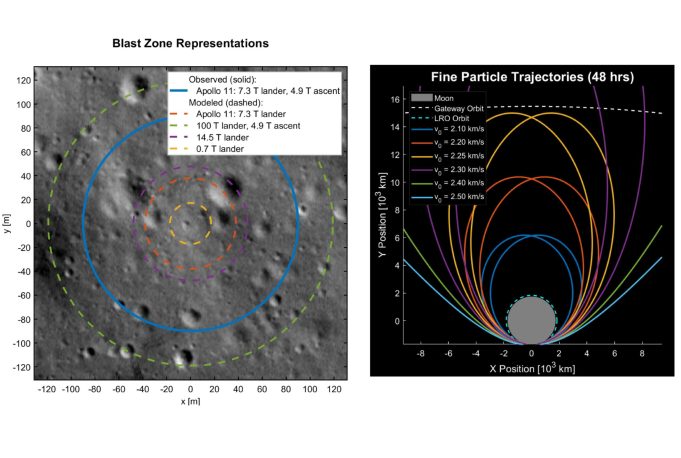
An increasing number of missions to the Moon are planned for the future. However, their long-term, cumulative impacts on the lunar environment are unknown. Research indicates that some important scientific discovery potential may be permanently lost, and exploration may become challenging due to effects of large-scale human activities. Motivated by these questions, we develop and present a generalizable systems-theoretic framework, called Sustainability Evaluations for Lunar Environment Exploration, for assessing the effects of human-built systems on the lunar environment. We contribute a scale and rate diagram of natural and anthropogenic processes on the Moon to provide comparative assessment of important processes that can dominate environmental effects and carry implications for human operations. Additionally, we derive metrics using functional-relationship diagrams of engineered systems to identify environmental effects based on exchange of matter, energy, and information. We demonstrate computation of two selected metrics: the area of the blast zone due to lunar landings and the trajectory of disturbed regolith mobilized from the lunar surface.