

Contact Info
Affiliated Labs
Biography
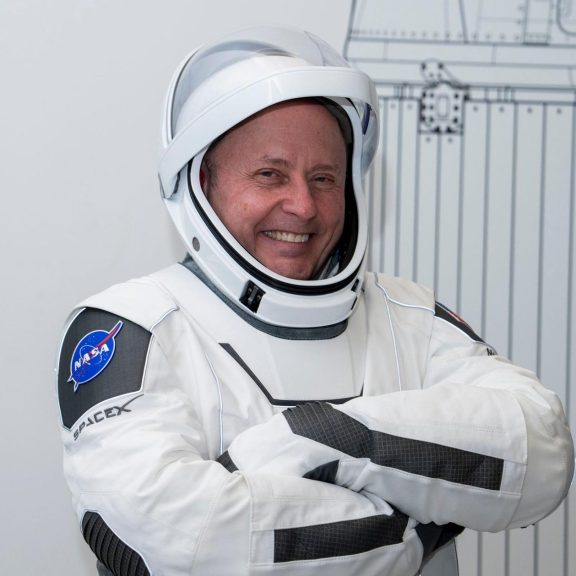
E. Michael “Mike” Fincke is a Professor of the Practice in MIT’s Department of Aeronautics and Astronautics and a member of the Human Systems Laboratory. He joined the MIT faculty in 2026 following a 30-year career as a NASA astronaut and service as a Colonel in the United States Air Force.
Fincke is a veteran of four spaceflights aboard Soyuz, Space Shuttle Endeavour, and SpaceX Crew Dragon, totaling 549 days in space. He served as an International Space Station science officer, flight engineer, and commander twice, and has completed nine spacewalks totaling 48 hours and 37 minutes in both the American and Russian spacesuits.
Throughout his NASA career, Fincke worked extensively on the development, integration, testing, and operation of human-rated spacecraft. His work included NASA’s Commercial Crew Program and the development of both SpaceX Crew Dragon and Boeing Starliner. He brings an operational spaceflight perspective to research and education, connecting engineering design and systems integration with human performance, mission operations, leadership, safety, and decision-making in high-consequence environments.
Specialization and research Interests
- Human spaceflight systems and operations
- Spacecraft systems integration and integrated testing
- System safety, risk management, and flight readiness
- Flight software and human-machine interfaces
- Spacecraft and space habitat design
- Extravehicular activity and spacesuit operations
- Human performance and decision-making in high-consequence environments
- Lunar and Mars exploration systems and operations
Teaching interests/Courses
- 16.00 — Introduction to Aerospace and Design
- Human spaceflight systems and operations
- Space systems engineering and integration
- Integrated testing, verification, and flight readiness
- Aerospace safety and risk management
- Spacecraft operations and mission planning
- Leadership, teamwork, and decision-making in operational environments
Academic degrees
- S.B., Aeronautics and Astronautics, Massachusetts Institute of Technology, 1989
- S.B., Earth, Atmospheric and Planetary Sciences, Massachusetts Institute of Technology, 1989
- M.S., Aeronautics and Astronautics, Stanford University, 1990
- A.S., Earth Sciences (Geology), El Camino College, 1993
- M.S., Physical Sciences (Planetary Geology), University of Houston–Clear Lake, 2001
- Distinguished Graduate, U.S. Air Force Test Pilot School, Class 93B
Society memberships
- American Institute of Aeronautics and Astronautics (AIAA) — Professional Member
- Association of Space Explorers (ASE) — Active Member
- The Explorers Club — Member
Positions held at MIT/outside of MIT
- Professor of the Practice, MIT Department of Aeronautics and Astronautics, 2026–present
- NASA Astronaut, 1996–2026
- Commander, International Space Station Expeditions 18 and 74
- Pilot, NASA SpaceX Crew-11
- Mission Specialist and spacewalker, STS-134, Space Shuttle Endeavour
- Science Officer and Flight Engineer, International Space Station Expedition 9
- Chief, Safety Branch, NASA Astronaut Office
- Chief, Commercial Crew Branch, NASA Astronaut Office
- Colonel, United States Air Force, retired
- Flight Test Engineer, United States Air Force
- U.S. Flight Test Liaison, Japanese/U.S. XF-2 fighter program
Awards & Honors
- NASA Distinguished Service Medal — four awards
- NASA Space Flight Medal — four awards
- International Space Station Leadership Award — inaugural recipient
- Defense Superior Service Medal
- Legion of Merit
Key publications
- Fincke, E. M., et al. (2012). “Multiscale kinetics of a field-directed colloidal phase transition.” Proceedings of the National Academy of Sciences, 109(18), 7392–7397.
- Fincke, E. M., et al. (2011). “Right ventricular tissue Doppler assessment in space during circulating volume modification using the Braslet device.” Acta Astronautica, 68(9–10), 1642–1649.
- Fincke, E. M., et al. (2010). “Extensional properties of a dilute polymer solution following preshear in microgravity.” Microgravity Science and Technology, 22(3), 313–319.
- Fincke, E. M., Padalka, G., Lee, D., van Holsbeeck, M., Sargsyan, A. E., Hamilton, D. R., Martin, D., Melton, S., McFarlin, K., and Dulchavsky, S. A. (2005). “Evaluation of shoulder integrity in space: First report of musculoskeletal ultrasound on the International Space Station.” Radiology, 234(2), 319–322.