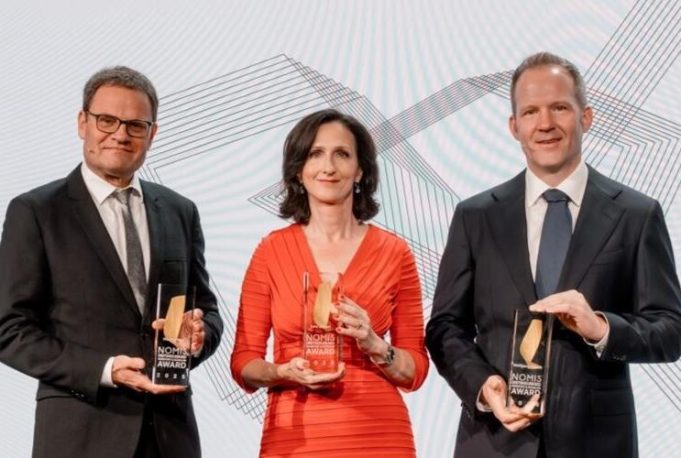
Prof. Sara Seager honored with 2025 NOMIS Award
Prof. Sara Seager was among the recipients of the 2025 NOMIS Distinguished Scientist and Scholar Award for her ongoing work exploring the chemistries that might support life on Venus and other extraterrestrial environments. NOMIS is a private Swiss foundation supporting insight-driven scientific endeavors across all disciplines, with an emphasis on researchers and their potential to inspire the world around them.
Fellow 2025 recipients include Markus Rex of the Alfred Wegener Institute and Wolfgang Busch of the Salk Institute for Biological Studies.
From Science.org:
“As inhospitable to life as Mars may appear, Venus probably has it beat. Its surface is a desiccated wasteland that reaches an average temperature of more than 450°C, shrouded by clouds of concentrated sulfuric acid.
But that’s no deterrent to Sara Seager, a planetary scientist at the Massachusetts Institute of Technology, who aims to comb through those clouds in search of signs of life. “Just like on Earth, when you go up in an airplane or hike up a mountain, it gets colder and colder—so too on Venus,” says Seager. “And there’s life in our clouds—bacteria that were temporarily swept up there.” Indeed, the iconic astronomer Carl Sagan first hypothesized the possibility of upper-atmospheric life on Venus over 60 years ago.
Seager’s interest was piqued by a 2020 study of the Venusian atmosphere that reported evidence for traces of phosphine gas. “Phosphine on Earth is only associated with life,” she says, noting that the levels of phosphine reported on Venus well exceed the miniscule amounts that could be generated by other mechanisms like atmospheric or volcanic processes. This study’s results remain controversial, however, and Seager became fixated on the search for alternative signatures that might reveal life on Venus.
“I decided to pursue space missions to Venus,” says Seager, who rallied sufficient private-sector support for the first in a series of unmanned sensor-laden craft, slated for launch in 2026. But the funders also wanted a clearer sense of what kind of chemical signatures the craft should be looking for—laying the foundation for the research proposal that won Seager the 2025 NOMIS Distinguished Scientist and Scholar Award.”