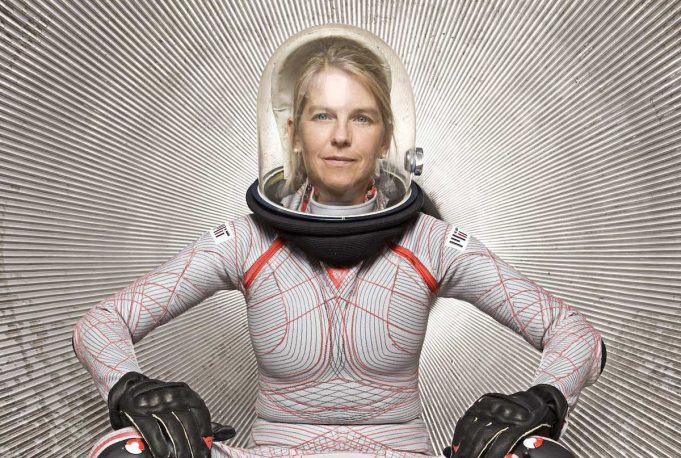
An Interview with Dava J. Newman, aerospace biomedical engineer, explorer, and educator
This interview was originally featured on the National Academy of Engineering’s series, “The Bridge.”
Ronald Latanision
I’d like to welcome everyone back to The Bridge series of interviews. We’re speaking today with Dava Newman, Apollo Program Professor of Astronautics and Director of the Human Systems Lab at the Massachusetts Institute of Technology, who is a long-term colleague of mine. Dava, it’s great to see you again and good to have you here. We’re also joined by David Butler, J. Herbert Hollomon Scholar at the NAE.
Dava J. Newman
Thank you so much—it’s really an honor and I’m so glad to join you, Ron and David. Let’s talk about the future!
Dr. Latanision
Let me start at the beginning. I identified your affiliation as the Apollo Program Professor at MIT. Could you give us a little bit more of a background? Where did you grow up and go to school? How did you choose aerospace engineering as your profession? We’ll start there to give our readers some context.
Dr. Newman
Absolutely. I’m going to start with a couple things that I’m super excited to talk with you about and I’ll cover some background as well. I really want to start with what I think is the most exciting quest right now—the search for life in the universe. When are we going to find life elsewhere? And that wonder, that awe—those questions that, maybe, people think can’t be answered have always been a spark for me, since I was a young girl growing up in Montana and with the Apollo program in the 1960s.
Human spaceflight taught me to dream. It taught me to look beyond. Looking up at the stars, of course, and the Moon was very prevalent in the Big Sky of Montana growing up. Apollo’s important idea for me was that anything’s possible, with vision, hard work, breakthrough technology, and so on. And, if we do it together—focusing on that vision that we have a mission and we work together—anything’s possible. Today, that translates to my excitement about the search for life in the universe, and looking at other planetary bodies, the solar system, and now looking at exoplanets.
I didn’t know I was going to be an aerospace engineer. There are no engineers in my family, except for one wonderful uncle. I really didn’t know what engineering was. So that took a while, until I got into college, when I started asking: What is engineering all about? Thinking, I’d love to solve problems. I’d love to think about teams working together to solve those “impossible” problems. And when I figured out that’s what engineers do, I said that’d be fantastic and switched my major. But you know, electrical engineering, I didn’t know if I could do that. Mechanical engineering—I could never really fix my car very well.
But space was a different story. Space was always exciting to me, both flight, the aeronautics aspect of it, and also astronautics. During my graduate work and doctoral work, I got to combine aerospace with biomedical engineering. And that really was the home run for me—this cross-disciplinary work where I can study astronauts and astronaut performance and apply engineering principles.
I had the great privilege of starting my faculty career at the University of Houston. They didn’t have aerospace, so I got to bring in some aerospace classes. Then I returned to MIT as a faculty member and had previously earned three degrees at MIT. My work focuses on human spaceflight, the breakthrough technology developments for both astronauts in space as well as on Earth—the dual use of our technologies.
I also got to dabble in policy, earning a second master’s degree in technology and policy and serving as director for a decade, which I know you’re both also interested in. It really is about how are we going to think about the future vision? I’ve always been an educator and it’s always about the next generation and my students. I had the great privilege to go to Washington, DC, and serve as NASA Deputy Administrator (the number two for the entire agency) with NASA Administrator Charlie Bolden during the Obama administration. My career kind of came full circle after that. I was very glad to come back to academia and MIT to get back to research and teaching.
Dr. Latanision
When you were in high school, did you have a teacher, a mentor, or someone who gave you some advice or some counsel on the direction you were heading? Or were your parents involved in any way in aerospace activities? How did you even think of it? When I think back, my decision to become a materials scientist was because I didn’t want to become a coal miner. I grew up in northeast Pennsylvania and mines were very tough on my family. I had a mentor in high school who gave me some really good advice and help. I’m curious about whether you had any similar experiences.
Dr. Newman
I grew up in a mining family as well in Montana. My grandpa Dave, who I’m named after, was a miner and state senator, but my folks and aunties were K-12 public school teachers, and so I think that kindled that love of education and learning in me. Early on, I still didn’t know what engineering was, but I was very good in the STEM fields. I had propensity and loved those fields, I just didn’t know where it was going to lead.
Today, I call it “STEAMD.” I always bring in the art, I always bring in design, because I want to make sure that the message is that STEM (STEAMD) needs to be open to everyone. I have the best job in the world, being the Apollo Professor, and I get to build things and design things and train astronauts and fly experiments into space. But we need everyone. So, I work with philosophers and poets, and artists, always the visionaries.
What I love about engineering (and how I kind of literally stumbled into it) is thinking about the teamwork needed and putting teams together to solve big, audacious problems. And very important, too, for our engineering ethic is that as we are designing and building. Whatever we do in engineering, it should be in service of humanity. Are we helping the human condition? I think that’s important to keep at the forefront.
Dr. Latanision
What is the mission of the Apollo program at MIT? Is it a large program? What are some of the specifics?
Dr. Newman
Well, so that’s my chair, the Apollo Program Chair, in honor of NASA’s Apollo Program. There’s a really great story here. You might know the name Robert Seamans from MIT and his NAE work.1 He was also NASA Deputy Administrator. He was a wonderful mentor of mine. How lucky was I that I got to meet Bob? He was the first engineer as deputy of NASA. Hans Mark was also a NASA Deputy Administrator. Those two were huge mentors to me.