
Earth Observation Symposium
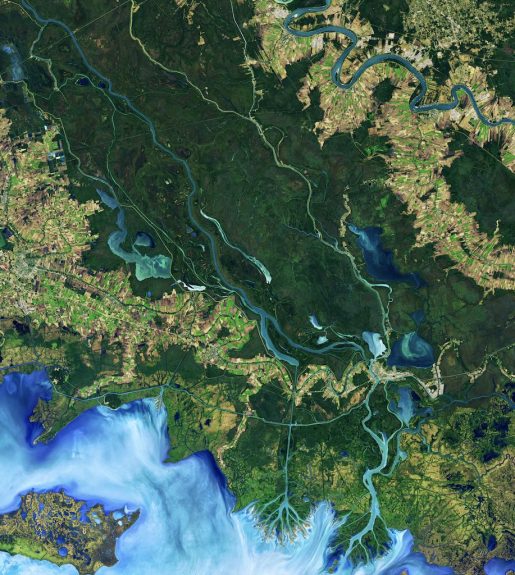
Join MIT AeroAstro and Earth, Atmospheric, and Planetary Sciences (EAPS) for the Earth Observation Symposium, a day-long exploration of satellite-based research and innovation for Earth Day on April 22 2026.
This symposium will convene researchers from across MIT and affiliated networks to highlight how satellites allow us to monitor weather systems, track climate change, study ecosystems, and better understand the patterns shaping our planet.
The program features a keynote address by Susan Solomon, Lee and Geraldine Martin Professor of Environmental Studies and Chemistry, internationally recognized for her leadership in atmospheric science. The day will also include faculty talks and panels, lightning talks and poster sessions from students and researchers, and opportunities to connect with colleagues working across this interdisciplinary field.
Celebrate MIT’s pioneering role in Earth observation, a field first explored right here in Boston, and join us in exploring how satellite science continues to advance research, technology, and society.
Program
Part 1
EAPS Atrium, Building 55
10:00–10:05 | Welcome and introduction | Prof. Olivier de Weck and Prof. Arlene Fiore
10:05–10:10 | Symposium overview | Prof. Daniel Varon and Dr. Afreen Siddiqi
10:10–10:40 | Keynote
Susan Solomon, Lee and Geraldine Martin Professor of Environmental Studies and Chemistry
Interpreting Earth observation regarding ozone, detection and attribution of climate change, and future challenges.
11:00–11:50 | Panel
Earth observation for environmental science and society: emerging technologies and applications
Sherrie Wang, Assistant Professor, MIT MechE, IDSS, and LIDS; PI of the Earth Intelligence Lab at MIT
Taylor Perron, Cecil and Ida Green Professor of Earth, Atmospheric and Planetary Sciences
Dava Newman, Apollo Program Professor, Aeronautics and Astronautics
Daniel Varon, Boeing Career Development Professor in Aeronautics and Astronautics
12:00–1:00 | Lunch + networking
1:00–2:00 | Lightning Talks
Students, faculty, and researchers on interdisciplinary topics in Earth Observation
2:00–3:30 | Featured Speakers
Xiong Liu, Senior physicist, Center for Astrophysics, Harvard & Smithsonian
TEMPO Mission: The Smithsonian/NASA TEMPO observatory measures the atmosphere over North America from a geostationary satellite, specifically tracking air quality in unprecedented detail.
Dara Entekhabi, Bacardi And Stockholm Water Foundations Professor, MIT Civil and Environmental Engineering
The Soil Moisture Active Passive (SMAP) Mission: Launched in 2015, the SMAP satellite measured high-resolution global measurements of near-surface soil moisture and its freeze-thaw state. These measurements allow significantly improved estimates of water, energy and carbon transfers between the land and atmosphere.
Vincent Leslie, Technical Staff, MIT Lincoln Laboratory
The NASA TROPICS CubeSat constellation mission is currently providing wide-swath microwave observations of tropical cyclones in twelve channels spanning 90-205 GHz at unprecedented revisit rates to improve our basic scientific understanding of how storms form and evolve and to improve our ability to forecast storm track and intensity.
Part 2
AeroAstro Neumann Hangar, Building 17
3:30–5:00: Poster session