About

Our Mission
In the MIT Department of Aeronautics and Astronautics, we look ahead by looking up. We lead innovation in aerospace systems and technologies that have world-changing impact. Educating the next generation of leaders, researchers, engineers, and entrepreneurs who will shape the future of aerospace, we foster a diverse, creative, and international community built on technical excellence and integrity. Working together with the public and private sectors, we aim to expand the benefits of aerospace to preserve our environment, strengthen global security, contribute to a thriving economy, and explore other worlds in the service of the nation and for the betterment of humanity.
Our vision is to push the boundaries of the possible in aerospace to ensure a lasting positive impact on our society, economy, and environment while creating a diverse and supportive community.
Our Values
Our department’s shared values guide how we execute our mission and lead in the aerospace field.
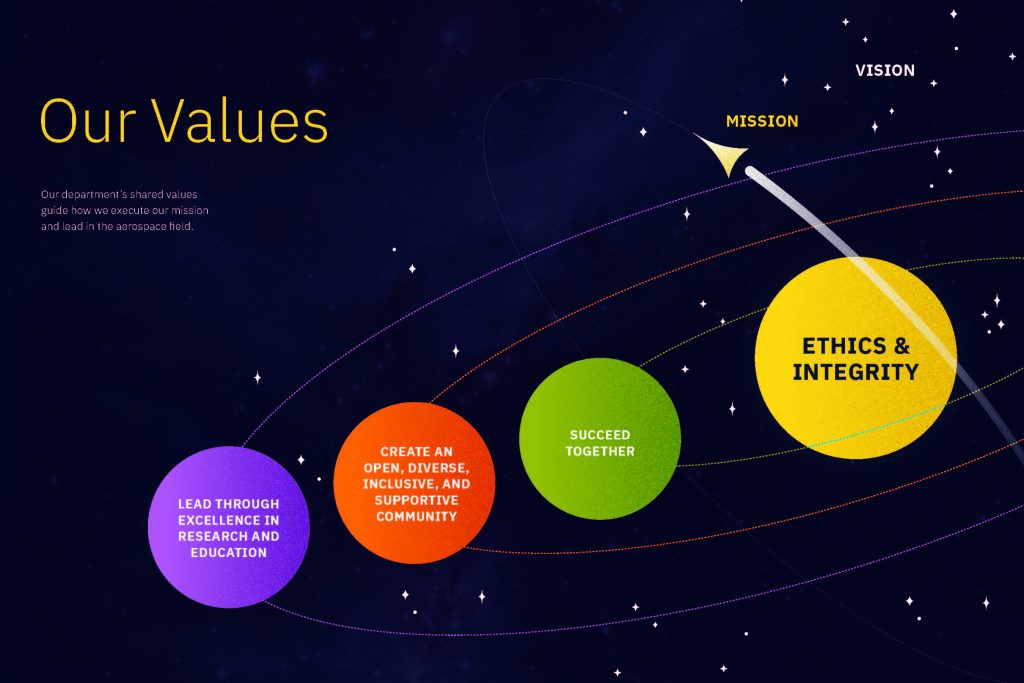
- Lead through excellence in research & education
We lead through the strength of our research, the depth of learning our students achieve, and the invention, innovation, and discovery from the interaction between research and education. - Create an open, diverse, inclusive, and supportive community
We work to support a thriving community that fosters belonging and learns by inviting members to give feedback and reflecting collectively on how we meet our values. - Succeed together
We collaborate across the aerospace ecosystem, draw strength from connectivity with the broader MIT community, and proactively engage with national and international partners in a spirit of mutual respect. - Ethics & integrity
We are committed to the pursuit of academic truth, adhering to the highest standards of safety and technical rigor and unwavering principles of honesty and accountability in all aspects of our work.
Course 16: Our Academic Programs
Whether you are passionate about flying machines, pushing the boundaries of human civilization in space, or high-integrity, complex systems that operate in remote, unstructured, and dynamic environments, you belong here.
Ranked among the top programs in aerospace engineering by US News & World Report for both graduate and undergraduate studies.
Upon leaving MIT, our students go on to become engineering leaders in the corporate world, in government service, and in education. Our alumni are entrepreneurs who start their own businesses; they are policy-makers shaping the direction of research and development for years to come; they are educators who bring their passion for learning to new generations; they are researchers doing transformative work at the intersection of engineering, technology, and science.
Undergraduate study in the department leads to the Bachelor of Science in Aerospace Engineering (Course 16), or the Bachelor of Science in Engineering (Course 16-ENG) at the end of four years. The AeroAstro undergraduate engineering education model motivates students to master a deep working knowledge of the technical fundamentals while providing the skills, knowledge, and attitude necessary to lead in the creation and operation of products, processes, and systems.
Graduate study in the Department of Aeronautics and Astronautics includes graduate-level subjects in Course 16 and others at MIT, and research work culminating in a thesis. Degrees are awarded at the master’s and doctoral levels. The AeroAstro graduate program offers opportunities for deep and fulfilling research and collaboration in our three department teaching sectors (full descriptions below) and across MIT. Our students work side-by-side with some of the brightest and most motivated colleagues in academia and industry.
Our Research Areas







Our Strategic Priorities
Strategic priorities are high-level initiatives pursued in tandem with our core capabilities. They support the mission and vision and align with our shared values.
These priority areas focus on long-term trends rather than specific systems. Together, they allow us to develop our strengths to best address the nation’s greatest challenges and opportunities in aerospace.
Read the latest AeroAstro Strategic Plan
Research Innovation Areas
- AI-Enabled Aerospace Design and Operations
Advance MIT AeroAstro as the premier institution for certifiable, safety-critical AI in aerospace by pioneering methods that integrate a wide range of AI capabilities across digital design, materials, manufacturing, and operations, and by educating AI-native graduates who can seamlessly leverage and embed artificial intelligence across aerospace systems. - Aviation for the Next Century
Strengthen MIT AeroAstro’s position as a world leader in next-generation aircraft, airspace management, and aviation systems modernization to address the critical infrastructure, systems integration, and carbon emissions challenges that are constraining aircraft deployment and limiting U.S. competitiveness in airspace modernization. - Leading-Edge Satellites and Systems
Position MIT as the preeminent institution for innovation in small satellite systems, constellations and operations by advancing technologies that enable novel sensing, communications and operations for constellation-scale deployment. - Long-Duration Space Exploration
Lead the field in enabling sustainable human activity beyond Earth through integrated innovation in advanced aerospace systems for launch, aerocapture, reentry, and propulsion, space-based manufacturing, cislunar operations, and human life support and health technologies that reduce costs, enable long-duration missions beyond low Earth orbit, and deliver transformative applications for life on Earth.
Education
The Department’s approach to education must evolve to maintain our core competencies while future-proofing our graduates in a changing industry. Our curriculum and pedagogy will empower students with the skills to look ahead and lead through change.
Our education priorities include:
- AI-Native Aerospace Engineers
Advance MIT AeroAstro as the premier institution for AI-native aerospace engineers who combine rigorous fundamental knowledge with advanced AI and digital engineering capabilities, producing graduates who can lead industry transformation. - Design-Build-Test
Enhance MIT AeroAstro’s undergraduate curriculum and graduate research opportunities to integrate substantial design-build-test experiences throughout students’ time in the department.
Culture and Leadership
As trends and needs in aerospace evolve, AeroAstro will lead the field and contribute to its continued growth through: providing mentorship and resources to an increasing number of students who wish to pursue entrepreneurship; expanding our professional and continuing education offerings; and fostering a sense of belonging throughout our community.
- Cultivate an environment of excellence
AeroAstro has made a concerted effort over several decades to make our community and the aerospace field a welcoming place for people from across the world, of all backgrounds, to do their best work. We recognize that we can only realize the full potential and impact of our teaching and learning, research, innovation, and service when inclusion and collaboration are core principles.
Through the Department’s leadership efforts and the initiatives we undertake, we commit to making sure everyone at AeroAstro can contribute and succeed. We will uphold excellence, rigor, and integrity in an environment where all individuals are supported without prejudice. - Industry collaborations and startup ecosystem
The Department has a long history of collaboration with government and industry to solve pressing challenges and innovate at the cutting edge of aviation, spaceflight, autonomy and computing. With the aerospace field experiencing a renaissance of entrepreneurship, led by venture-backed startups and characterized by rapid innovation, AeroAstro leadership remains committed to exploring collaborations with both traditional and new research partners and training students for the dynamic field they will enter.
Leadership & Administration
Faculty Leaders








Administration (Headquarters Staff)

Robin Courchesne-Sato

Rachael Aitchison

Janine Liberty

Brían O’Conaill

Eunice Nganga

Denise Phillips

Kate Reynolds

Esther Allen

Marie Stuppard