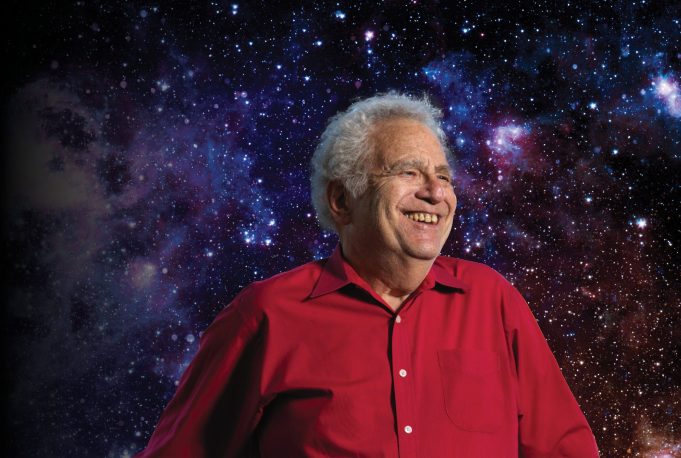
Planetary Society Cofounder Keeps Reaching for the Stars
This article originally appeared in Slice of MIT.
In 1957, at the height of the Cold War, the Soviet Union announced it had launched Sputnik 1, the world’s first artificial satellite. For much of the United States, the announcement came as a shock. For Louis “Lou” Friedman PhD ’71, it was a revelation. “That event changed my life trajectory,” recalls Friedman, who was just starting college at the time. “Suddenly, space exploration wasn’t something you read about in science fiction novels. It was a viable field, a field that I could study, and where I felt I could apply my aptitude in mathematics and science.”
Raised in Bronx, New York, Friedman studied mathematics and engineering as an undergraduate at the University of Wisconsin, Madison, then earned his master’s degree from Cornell University with a thesis on interplanetary trajectories. In 1963, he moved with his family to Andover, Massachusetts, to work in the space systems division at Avco and began chipping away at a PhD in aeronautics and astronautics at MIT. “Avco gave us eight hours a week to attend classes and paid our tuition,” he says. “On days when I couldn’t get a ride to school, I used to take the commuter train for North Station. When it slowed down in Cambridge I would open the door, step off, and walk to campus.”
The 1960s and early 1970s were exciting times for space exploration. At MIT, and later at the Jet Propulsion Laboratory (JPL) in Pasadena, California, Friedman tracked data from NASA’s Mariner missions to Mars and Venus. He calculated trajectories for spacecraft and helped plan a mission—never realized—for a solar sail craft to intercept Halley’s Comet on its scheduled return to the solar system in 1986. He also worked on the design of the Voyager and Galileo missions. “MIT was fundamental in determining my career path,” he says. “At MIT I worked on gravity-assist trajectories for space missions. I established contacts with JPL and ended up working there for a decade.”
By the end of the 1970s, NASA’s priorities shifted from exploration to the space shuttle. To keep the exploration flame alive, Friedman joined JPL Director Bruce Murray and planetary scientist and Cosmos TV series creator Carl Sagan in 1979 to form the Planetary Society, a nonprofit whose stated focus is “empowering the world’s citizens to advance space science and exploration.”
Friedman, who still lives in California, served as executive director of the Planetary Society from its founding until 2010, when the leadership passed to Bill Nye (famous as “the Science Guy”). He initiated several projects there including sending privately funded payloads to Mars, testing Mars rovers, and launching a new solar sail project. In 2019, the society launched the crowdfunded spacecraft LightSail 2 to demonstrate that a spacecraft could be powered by the momentum of photons it received from the sun. “We calculated that LightSail 2 might stay aloft for a few months,” Friedman says. “Instead, it operated successfully in orbit for more than two years.”
During his retirement, Friedman has written three books, including a memoir titled Planetary Adventures: From Moscow to Mars. And while he acknowledges that space exploration isn’t in the headlines these days as often as quantum computing and AI, he remains hopeful about future ventures into outer space. “I don’t think there is anyone who thinks space exploration is a bad idea, because it’s a very positive part of human vision,” he says. “We will always want to know more about what’s out there.”