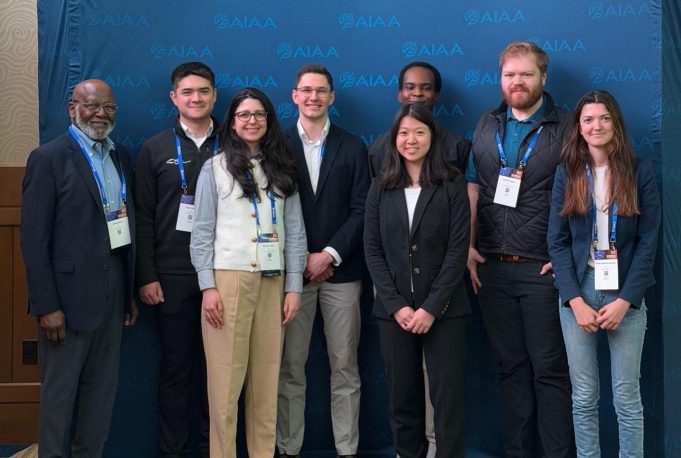
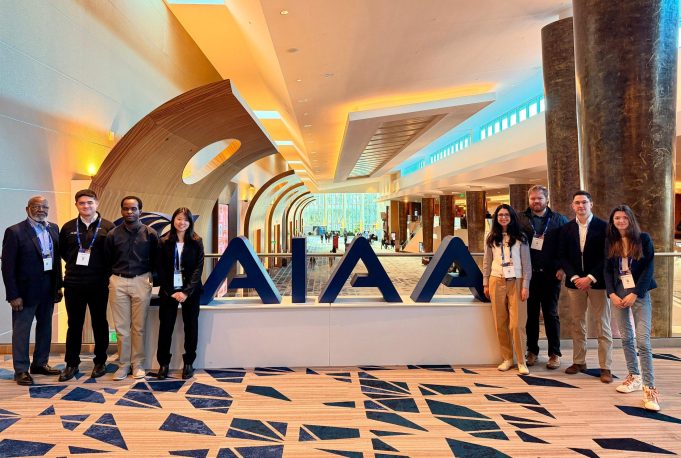
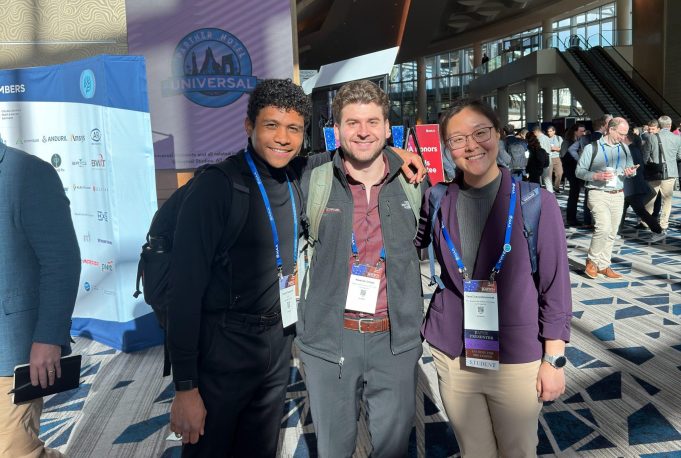
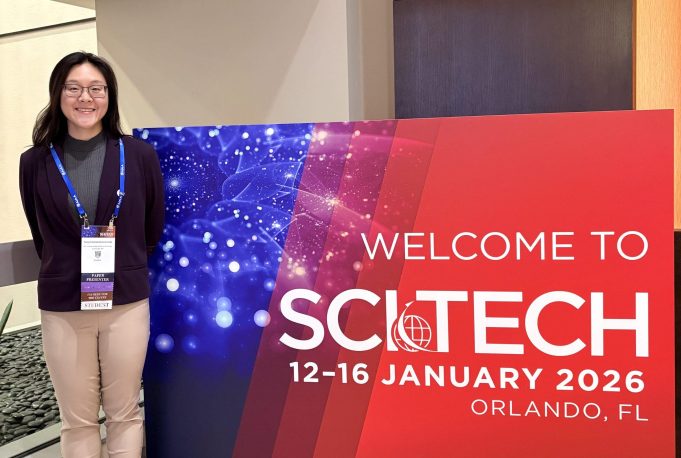
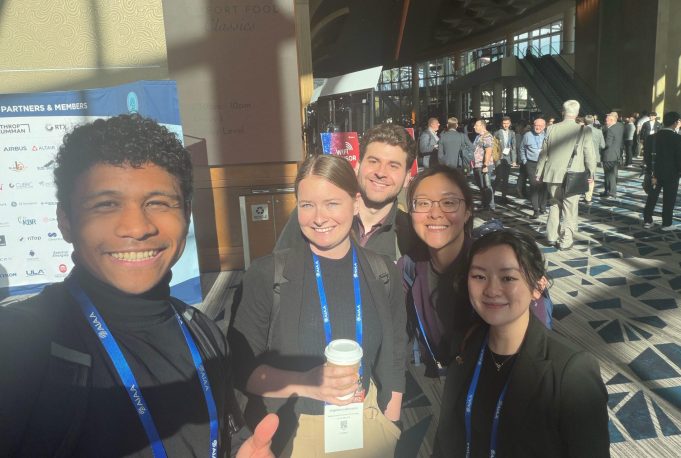
The AeroAstro community had a strong presence at the AIAA SciTech Forum, the world’s largest aerospace research and technology conference, with students and faculty sharing work that spans autonomy, space systems, and hypersonics.
Below are some research highlights from the event:
DINaMo
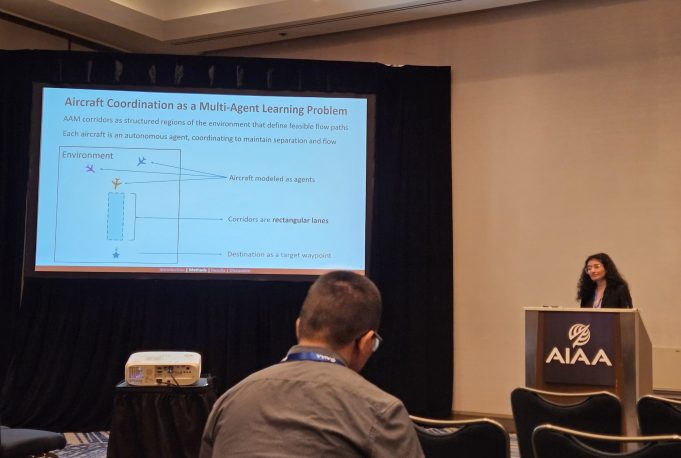
Jasmine Jerry Aloor presented work co-authored with her advisor Prof. Hamsa Balakrishnan, “Air Traffic Management for Advanced Aircraft Concepts.” The research demonstrates autonomous aircraft successfully self-organizing into corridor flows in decentralized settings without centralized traffic management, maintaining high corridor compliance.
Engineering Systems Laboratory
Yana Charoenboonvivat presented “Surface Power Demand Modeling for Human Martian and Lunar Missions,” co-written by her advisor Prof. Olivier de Weck, outlining a tool to quantify surface power demand for crewed missions to the Lunar and Martian surface.
Hypersonics Research Lab
Six members of the Hypersonics Research Lab presented their work:
A Data-Driven k-Equation-Based Framework for Modeling Turbulence Using Sparse Regression
Hugh Cairney and Wesley L. Harris
A machine learning–augmented, one-equation eddy viscosity turbulence model is developed using sparsity-promoting regression to learn interpretable turbulent length scales from data, demonstrating improved prediction of separated flows over standard models in unseen geometries.
Ignition and Combustion of Steels in Hypersonic Flows: A Coupled Formulation
Hillel Dei, Mauricio Bautista Aguilar and Wesley L. Harris
A coupled oxidation–combustion boundary-layer model is applied to quasi-steady hypersonic stagnation-point flows to better predict ignition and burning of bare metal alloys in Mach 4–9 flight conditions not captured by existing metallic-combustion models.
Effects of Cavity Geometry and Thermochemistry on Optical Systems in Hypersonic Vehicles
Grace Mao and Wesley L. Harris
This work investigates the effect of different cavity geometries of optical systems in hypersonic vehicles on optical distortion to characterize the signal quality.
Numerical Investigation of the Aeroelastic Response of a CFCF Compliant Panel in Hypersonic Flow
Myrella Cabral, Wesley L. Harris, and Earl Dowell
This work investigates the aeroelastic response of a Clamped-Free-Clamped-Free (CFCF) compliant panel subjected to hypersonic flow, with emphasis on understanding the flow physics governing the behavior of the aeroelastic response.
Computational Fluid Dynamics Modeling of Plasma Assisted Combustion in High Speed Flows
Geoffrey Svensson and Wesley L. Harris
A new modeling approach is developed to simulate plasma-assisted combustion in scramjet engines through a novel plugin for the US3D CFD code, aiming to address the challenges of modeling and testing supersonic combustion by reducing ignition delays and extending blowout limits.
Generative Deep Learning Models for Supersonic and Hypersonic Flow Fields
Paula Gutierrez Cascales, Wesley L. Harris and Chris Cantwell
This study compares convolutional and graph neural networks for predicting supersonic and hypersonic flow fields with strong discontinuities across varied Mach numbers, angles of attack, and geometries, assessing their ability to capture features such as bow shocks and expansion waves more efficiently than traditional numerical schemes.